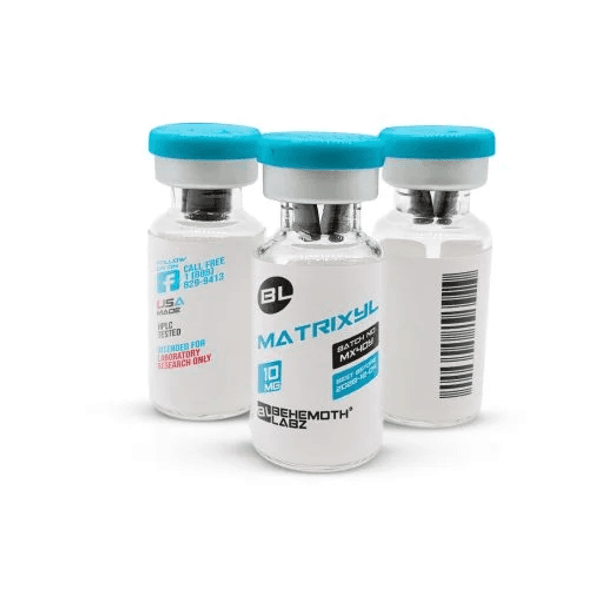
Matrixyl (Palmitoyl Pentapeptide-4)
Collagen-fragment peptide with the best placebo-controlled evidence in this class.
For research purposes only. These products are not intended to diagnose, treat, cure, or prevent any disease. By purchasing, you confirm these products will be used for legitimate research purposes.
About Matrixyl (Palmitoyl Pentapeptide-4)
Matrixyl is palmitoyl pentapeptide-4, or pal-KTTKS — the KTTKS sequence is a fragment of type I procollagen, and its presence signals to fibroblasts that collagen has been broken down, prompting them to make more. The palmitoyl chain was added for one reason: KTTKS on its own is hydrophilic and does not cross the stratum corneum well. It has the strongest evidence of any peptide in this group. A 12-week double-blind, placebo-controlled, split-face study in 93 women aged 35–55 compared a moisturiser against the same moisturiser containing pal-KTTKS, and found significant improvement in wrinkles and fine lines by both quantitative image analysis and expert grading, with no irritation. Note the concentration in that trial: 3 parts per million. A 10mg research vial contains enough peptide for roughly three kilograms of finished cream at the studied level, which is a useful sense of scale before reconstituting one like an injectable.
Key Benefits
- Significant wrinkle and fine-line improvement vs placebo in a 12-week split-face trial
- Well tolerated with no irritation reported in that study
- Palmitoylated specifically to improve skin penetration
- Mechanism is a plausible procollagen-fragment signal to fibroblasts
Set a goal (top of the page) to see how Matrixyl (Palmitoyl Pentapeptide-4) scores against it, and what the better-evidenced alternatives are.
Category Ratings
How to Take
Common Side Effects
- Well tolerated in the published trial with no irritation
- Contact irritation or sensitivity is possible with any topical
- Not evaluated for injection — no safety data exists for that route
Legal & Regulatory Status
Sold as a cosmetic ingredient and as a research chemical; not a drug and not FDA-approved for any indication. Cosmetic ingredients are not required to demonstrate efficacy before sale.
Safety and regulatory details for FDA-approved compounds are drawn from the official product label via openFDA; clinical development status reflects ClinicalTrials.gov. This information is provided for research reference, is not endorsed by the FDA, and may not be complete or current.
Research & Sources
- Topical palmitoyl pentapeptide improves photoaged human facial skin — 12-week double-blind placebo-controlled split-face trial, 93 subjects (PMID 18492182)
- Dermal stability and in vitro skin permeation of KTTKS and palmitoyl-KTTKS (PMID 25143811)
- Double-blind randomized trial: acetylhexapeptide-3 vs palmitoyl pentapeptide-4 cream for crow's feet (PMC10005804)
Sources are selected for reliability (peer-reviewed literature, openFDA, ClinicalTrials.gov) but this is a research summary, not medical advice, and may not be exhaustive.
Prices at quality-checked sources · as of August 2026 (10 days ago)
- 10mg $19.10
Observed on each vendor’s public listing — see how these sources are vetted. Peptide Concierge doesn’t sell peptides and isn’t affiliated with any vendor; confirm current pricing at the source.
Builds a working set shared across the stack builder, calculator, scheduler and compare.