IGF-1 LR3 / BPC-157 Blend
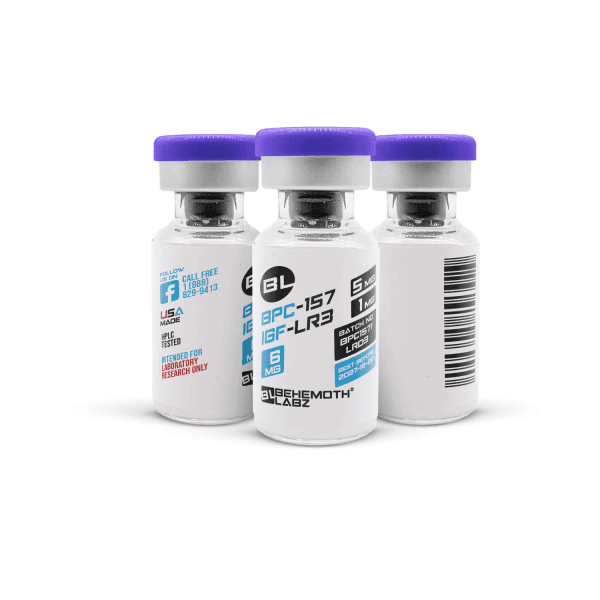
Growth signalling plus tissue repair — 5mg BPC-157 to 1mg IGF-1 LR3.
For research purposes only. These products are not intended to diagnose, treat, cure, or prevent any disease. By purchasing, you confirm these products will be used for legitimate research purposes.
About IGF-1 LR3 / BPC-157 Blend
A 6mg vial containing 5mg BPC-157 and 1mg IGF-1 LR3, also offered with the arginine-salt form of BPC-157, which the vendor describes as more stable. The two components genuinely do different things — IGF-1 LR3 drives growth signalling through the type-I IGF receptor while BPC-157 is used for tissue repair through separate pathways — so this is not a redundant pairing. Both are preclinical, which sets the tier. The practical issue is the fixed 5:1 ratio against very different dose scales: BPC-157 is conventionally used in hundreds of micrograms, IGF-1 LR3 in tens, and a single ratio cannot serve both without compromising one. IGF-1 LR3 also lowers blood glucose, so carbohydrate should be available — a requirement that carries over to the blend and is easy to overlook when the vial is labelled for its BPC-157 content. No study has examined the combination.
Key Benefits
- Two genuinely distinct mechanisms rather than redundant ones
- Arginine-salt BPC-157 option offered for improved stability
- Single vial rather than two reconstitutions
Set a goal (top of the page) to see how IGF-1 LR3 / BPC-157 Blend scores against it, and what the better-evidenced alternatives are.
Category Ratings
How to Take
Common Side Effects
- Hypoglycaemia from the IGF-1 LR3 component
- Injection site irritation
- Theoretical risk of promoting growth in existing tumours
- Fixed 5:1 ratio forces a compromise on one component's dose
Legal & Regulatory Status
Research use only; not FDA-approved. Both components are preclinical for these uses and no study exists on the combination. IGF-1 LR3 is WADA-prohibited.
Safety and regulatory details for FDA-approved compounds are drawn from the official product label via openFDA; clinical development status reflects ClinicalTrials.gov. This information is provided for research reference, is not endorsed by the FDA, and may not be complete or current.
Research & Sources
- BPC-157 multifunctionality & possible medical application — literature review (PMID 40005999)
- Des(1-3)IGF-I and IGF-I analogue potency — IGFBP escape mechanism context (PMID 8930132)
Sources are selected for reliability (peer-reviewed literature, openFDA, ClinicalTrials.gov) but this is a research summary, not medical advice, and may not be exhaustive.
Prices at quality-checked sources · as of August 2026 (10 days ago)
- 5mg BPC-157 + 1mg IGF-1 LR3 (6mg total) $163.976mg total, BPC-157 Arg form $171.96
Observed on each vendor’s public listing — see how these sources are vetted. Peptide Concierge doesn’t sell peptides and isn’t affiliated with any vendor; confirm current pricing at the source.
Builds a working set shared across the stack builder, calculator, scheduler and compare.